CVT Agentic Systems / Field Note 001
Meta / Claude / Shopify
Commerce Intelligence Through Agentic Orchestration
From Advertising Spend to Commercial Intelligence.
Proposed Solution Architecture
Cerevant Advisory / Agentic Systems
Commercial challenge
Advertising platforms describe spend and engagement; commerce systems describe orders, returns and inventory. Reviewing them separately can obscure whether a campaign contributes to commercial value. This proposal explores a governed view of acquisition cost, conversion, net revenue and product availability, with explicit limits on attribution and data quality.
Cerevant proposed architecture
Meta Ads API and Shopify Admin API would connect through scoped integration services. The six stages below describe the intended hierarchy. The governance control plane applies across every stage, including ingestion, model access, recommendations, execution and feedback.
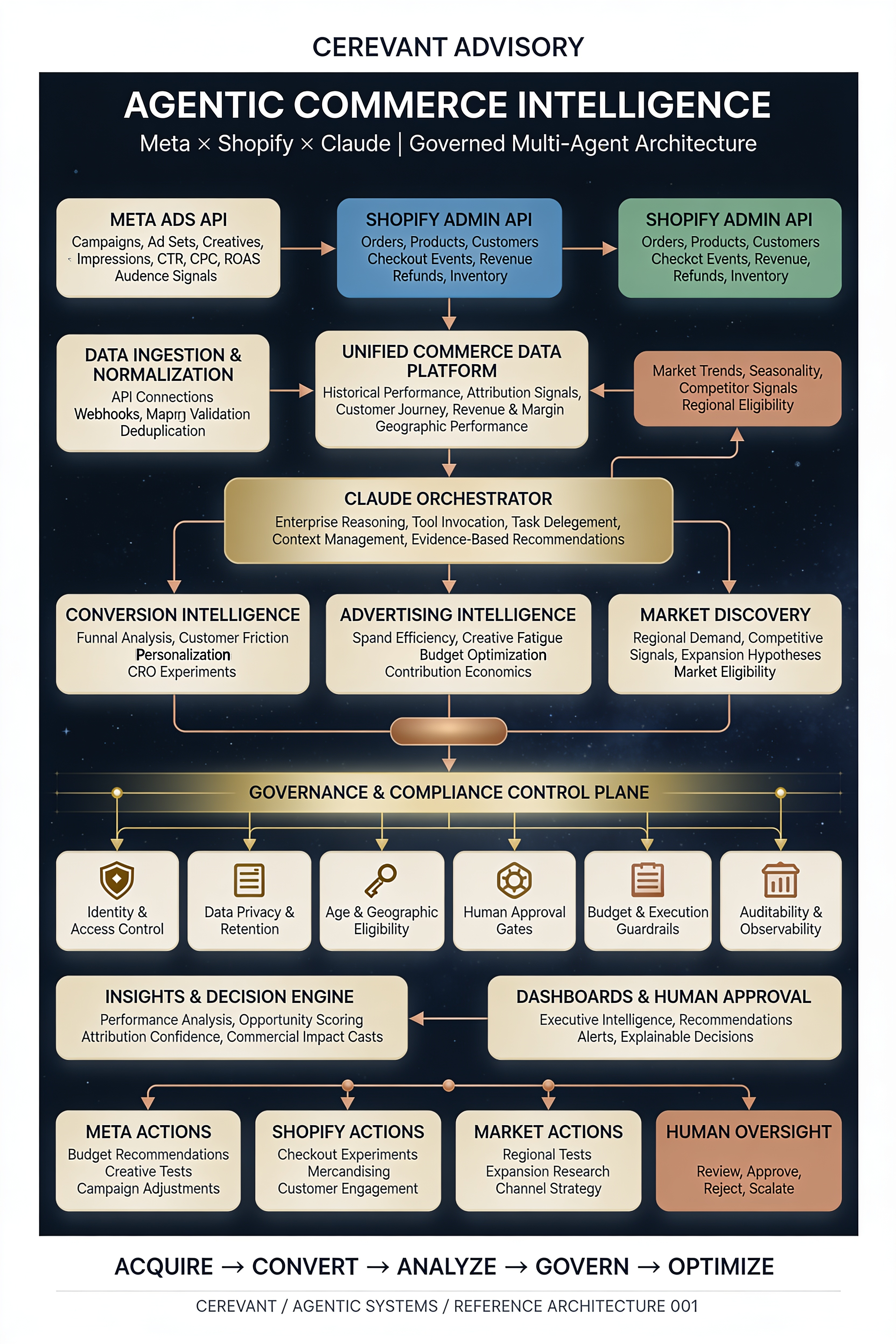
Expand or collapse the six-stage architecture specification
- Meta Ads API + Shopify Admin API
Separate read credentials from execution credentials. Admit only approved accounts, stores and data scopes.
- Data ingestion and unified data layer
Validate schemas and freshness; normalize campaign, product, order and refund data. Maintain lineage, access boundaries and retention rules.
- Claude orchestration and specialist agents
Route bounded analytical tasks to the three specialists. Broker tool calls through authenticated services with policy enforcement.
- Insights and decision engine
Combine evidence into ranked proposals with confidence, assumptions and commercial constraints. Block unsupported recommendations.
- Dashboards, approvals and execution
Present evidence to an accountable reviewer. A separate execution gateway checks approval, permissions and limits before any API write.
- Continuous optimization feedback loop
Compare observed results with the approved hypothesis. Feed outcomes and exceptions back into analysis; any new action passes authorization again.
Three specialist agents
The proposed specialists share governed evidence, while keeping their analytical responsibilities distinct. Their outputs are recommendations until separately authorized.
- Advertising performance agent: analyzes campaign spend, delivery, creative and acquisition signals; proposes bounded tests.
- Commerce performance agent: analyzes conversion, net sales, refunds, inventory and available margin inputs; flags commercial constraints.
- Commercial intelligence agent: reconciles advertising and commerce evidence, surfaces attribution uncertainty, and prioritizes opportunities against business goals.
Governance and compliance
The proposed Governance & Compliance Control Plane spans the complete architecture. These controls belong in identity systems, data services, policy enforcement gateways and operational tooling. Claude instructions alone cannot enforce them.
Governance & Compliance Control Plane
- Identity and access: authenticated service identities, vaulted credentials, least-privilege API scopes and separate read/write roles; deny unauthorized tool calls.
- Data privacy and permitted usage: field allowlists, minimization and redaction before model access, dataset access policies and enforced retention/deletion schedules.
- Alcohol eligibility: encode counsel-approved advertising, age and geographic eligibility rules in a versioned policy service. Validate proposed targeting and creative before release; unknown or ineligible cases are blocked for review.
- Human authorization: require a named approver and a time-limited authorization bound to the exact action payload. Changed or expired proposals require fresh approval.
- Budget and write-back guardrails: apply per-action and aggregate spend caps, destination allowlists, rate limits, idempotency and a kill switch in the execution gateway. Recheck current budget before each write.
- Audit and exceptions: record evidence lineage, model/tool versions, policy decisions, approvals and API results in access-controlled audit logs. Monitor failures, quarantine invalid inputs, alert owners and suspend writes on control failure.
Policy evaluation fails closed at each consequential boundary. Approval does not bypass access, eligibility or budget checks. These are proposed enforcement mechanisms, not controls implemented by this publication.
Business outcomes sought
The intended outcomes are faster evidence review, clearer spend-to-commerce visibility, better prioritization of experiments and accountable execution. A pilot should establish baselines for analyst review time, reconciliation coverage, recommendation acceptance and authorized-action exceptions. Incremental commercial impact requires a suitable experiment; platform attribution alone does not establish causality. No client results or performance gains are claimed.
Implementation considerations
Begin with a read-only pilot and an agreed measurement plan. Confirm API access, data contracts, identifier mapping, currency/time-zone alignment, attribution windows, refund treatment and inventory freshness. Use approved cost inputs before drawing margin conclusions.
Assign business, security, privacy and compliance owners. Validate permitted platform usage and applicable alcohol policies for each market before enabling actions. Test stale data, conflicting evidence, prompt injection, denied permissions, expired approvals, budget races and partial API failures. Introduce bounded writes only after review of control evidence, recovery procedures and monitoring. Platform permissions and market eligibility require implementation-time verification.